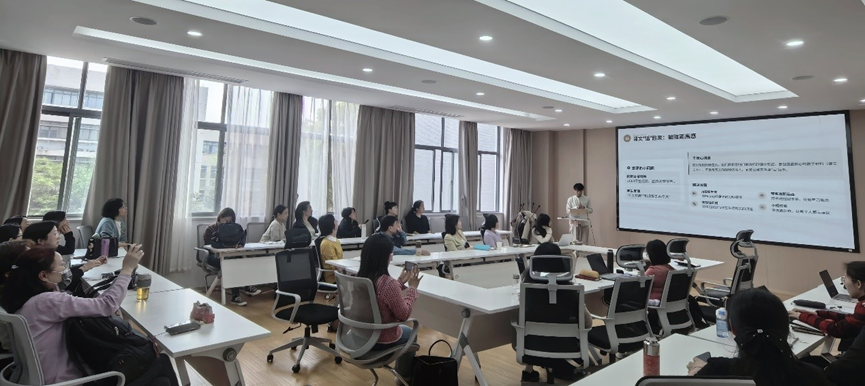
To further improve the quality of college English teaching and explore the integration and application of AI technology in English teaching, all college English teachers gathered in Room A349 of the School on the afternoon of April 15 for a teaching seminar—the AI Smart Teaching Workshop. Technical experts and frontline teachers shared the innovative application of artificial intelligence tools in college English teaching, and demonstrated school-based cases and broad prospects of technology-enabled education.
First, technicians from Pigai Platform introduced the core functions and application value of the intelligent composition grading system. The system supports automatic scoring, key point detection and text similarity comparison, and delivers diverse feedback including voice comments and sentence-by-sentence reviews. The adoption of this tool reduces teachers’ workload on repetitive marking. Meanwhile, instant and detailed feedback enables students to identify their deficiencies in a timely and clear manner, thereby realizing the goal of promoting learning through assessment.
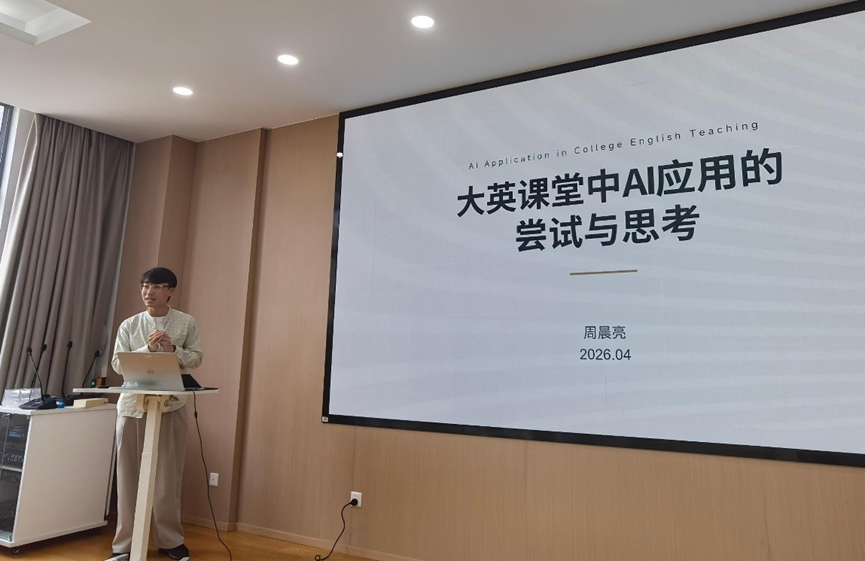
Next, Teacher Zhou Chenliang shared innovative practices of AI tools in daily teaching. He adopted text-to-video tools to convert textbook contents into short videos, and compiled core vocabulary of each unit into concise and humorous podcast dialogues, which greatly boosted students’ engagement. He also proposed plans to involve students in podcast production and build an intelligent cloud learning system, aiming to transform students from passive knowledge recipients to active creators. On the one hand, AI technology lowers the threshold for developing multimedia teaching resources, enabling general teachers to efficiently produce high-quality, personalized teaching materials. On the other hand, vivid and engaging presentation methods stimulate students’ learning interest and enhance their independent learning capabilities.
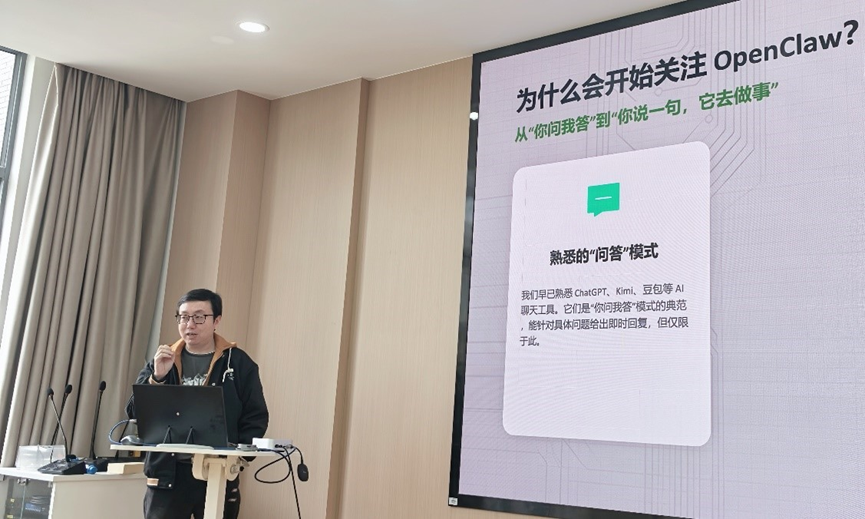
Finally, Teacher Jin Bo presented the application of Openclaw in teaching and research administration. Teachers can issue natural language commands for the system to generate and automatically save documents, and set regular literature crawling and data entry into forms. This eliminates the fragmented operation of manual copying and pasting required by conventional AI tools, freeing teachers from trivial repetitive work and allowing them to focus on creative tasks. Nevertheless, such systems have specific operating environment requirements, along with cost and data security concerns. Teachers are advised to make prudent choices based on practical needs.
Faced with the challenges of the new era, college English teaching must pursue proactive reform. It is essential to address practical difficulties in teachers’ professional development and actively explore effective approaches to technology-enabled teaching. The introduction of artificial intelligence tools offers new solutions to long-standing drawbacks in traditional teaching, helps arouse students’ learning enthusiasm and ease teachers’ work burden. Moving forward, the college English teaching team will further advance teaching reform, strengthen teacher training and deepen technological application, striving to build a more efficient and dynamic new ecosystem for college English education.